Turning a Lost Day Around
A 3-minute read
Every researcher knows the feeling. You sit down with a clear plan, and somewhere between checking one email and reading “just one more” article, the afternoon disappears. By the time you notice, the light outside has changed and the draft you meant to finish has not moved.
What happens next matters more than the hours already gone. Most of us react in one of two unhelpful ways: we give up on the day entirely, or we punish ourselves by staying glued to the desk, tired and frustrated, producing very little. Neither choice repairs the day. Both make tomorrow harder.
Over time I have settled on a simpler approach. It starts with one honest question.
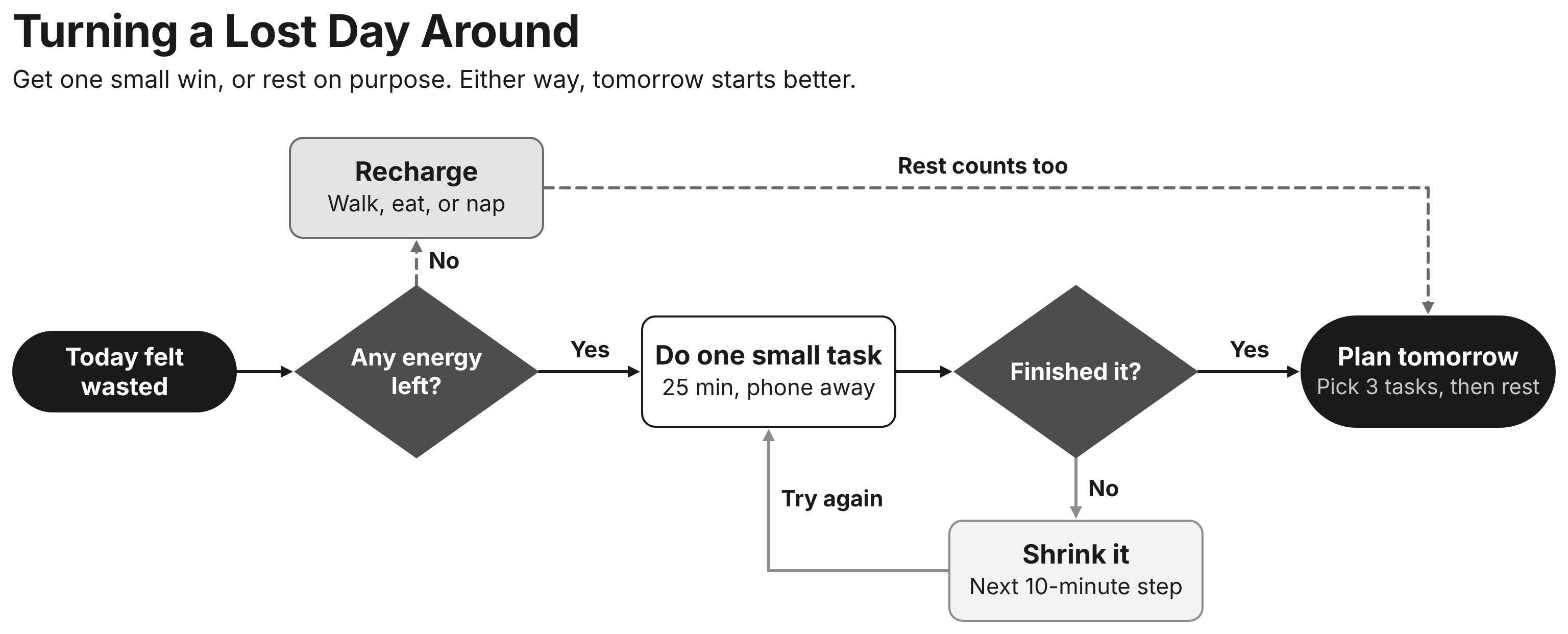
Ask: do I have any energy left?
Not motivation, energy. Motivation is a feeling that comes and goes. Energy is practical: can I focus for twenty-five minutes right now? The answer decides which of two paths I take.
No energy? Recharge on purpose
If the honest answer is no, I stop trying to force it. I step away and do something that actually refills the tank: a walk around campus, a snack, a short nap, a call with a family member or a friend. The key words are “on purpose.” Scrolling on my phone at my desk is not rest. It is just a slower way of losing time.
Before closing the laptop, I take two minutes to plan tomorrow. I write down three tasks, no more, and the time I will start. That small act changes how the day ends. Instead of “I got nothing done,” the story becomes “I reset, and tomorrow is ready.”
Some energy? Do one small task
If I can focus at all, I pick one task I can finish in about twenty-five minutes. I set a timer. The goal is not to make up for every lost hour. The goal is one finished thing, such as:
- Writing the first paragraph of a methods section
- Fixing the labels on one figure
- Answering the one email that is blocking progress
- Reading and summarizing one paper
Not finished? Shrink it
Sometimes the timer ends and the task is not done. That usually means the task was too big, not that I failed. So I shrink it. “Write the discussion” becomes “list three points the discussion must make.” “Fix the model” becomes “find the line where the error starts.” Then I try again with the smaller step.
When it is done, I write it down. A short note like “finished the Figure 3 caption” is proof that the day counted. Then I plan tomorrow, exactly as in the first path.
“Success is the product of daily habits, not once-in-a-lifetime transformations.”
James Clear, Atomic Habits
Why this works
Both paths end in the same place: a plan for tomorrow. That is intentional. A wasted afternoon only becomes a wasted week when it carries guilt into the next morning. Ending with three clear tasks and a start time gives my future self a running start.
The approach also replaces a vague feeling (“I am behind”) with concrete questions I can answer in seconds. Do I have energy? Did I finish? Is the task too big? Each answer points to a clear next step.
The whole process in one figure
Lost days will keep happening. They happen to everyone, including the most productive people you know. You do not need to win back every hour. You only need to make the next step smaller, kinder, and clear. Sometimes that is one finished task. Sometimes it is a walk and a short list for tomorrow. Both count.